If you shoot semi-auto, your trigger finger is the slowest part of the system. A forced reset trigger is the fix, and it’s the design Rare Breed built an entire category around. Here’s what an FRT really is, start to finish.
By Rare Breed Triggers · Reading time ~6 min · Updated 2026
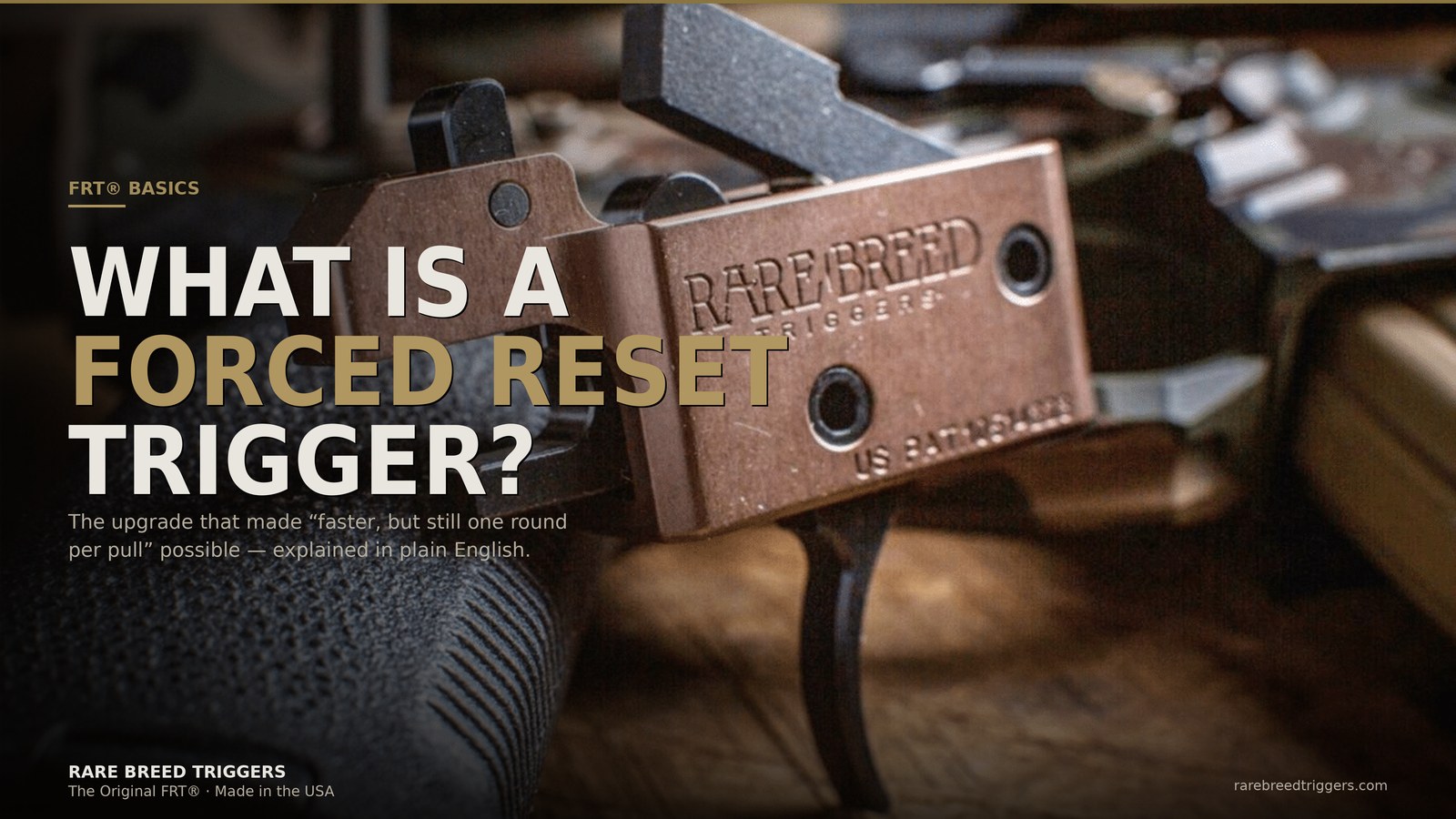
A forced reset trigger (FRT) is a semi-automatic replacement trigger that uses the firearm’s own cycling to push the trigger back to its forward, reset position after every shot. You still pull once for each round fired, but because the reset is driven mechanically instead of by your finger, each follow-up shot is faster and more consistent.
The one-sentence version
A forced reset trigger gives you a faster, more consistent shooting rhythm, while keeping the one rule that defines semi-automatic fire: one pull of the trigger, one round.
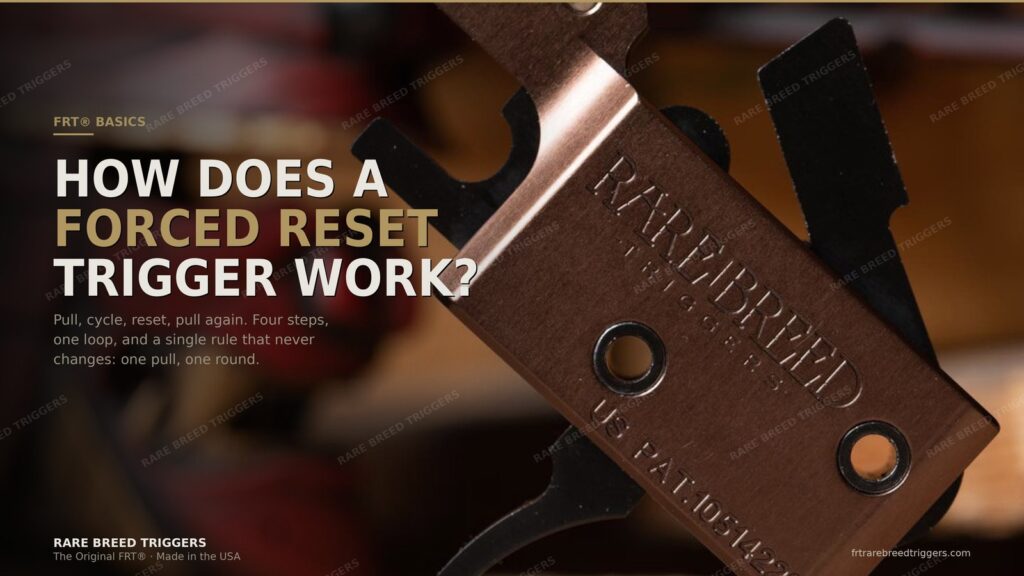
That single idea is worth slowing down on, because almost every question people have about FRTs, how fast they are, whether they’re legal, how they differ from a binary trigger, comes straight back to it. Once the reset makes sense, the rest falls into place. If you’d rather watch the sequence play out step by step, our companion guide on how a forced reset trigger works breaks the cycle down frame by frame.
Why the “reset” is the whole story
Every trigger has a reset point: the spot it has to travel forward to before it can fire again. On a normal trigger, getting back to that point is your job. Between shots, you release the trigger just far enough, then press again. Do it too little and the trigger never resets; too much and you’ve wasted motion. Shooting fast and clean means doing that perfectly, over and over, and that’s genuinely hard.
A forced reset trigger takes that job off your finger. As the action cycles to chamber the next round, the FRT borrows a little of that energy and uses it to drive the trigger forward into reset for you, the same way, every time. Your finger simply rides along and presses again. That’s the “forced” in forced reset: the firearm forces the trigger back to ready, so you don’t have to think about it.
An FRT doesn’t pull the trigger for you. It just hands the trigger back, faster and the same way, every shot.
The forced reset cycle: pull fires one round, the action cycles, the trigger is driven forward to reset, and you pull again for the next shot.
What it feels like to shoot
On a Rare Breed FRT®, the reset is short, crisp and positive, you can feel the trigger snap forward under your finger and stage for the next shot. You hold light, steady forward pressure, let the trigger come back to you, and break the shot again when your sights are where you want them. It feels fast, but never runaway, because nothing happens until you press.
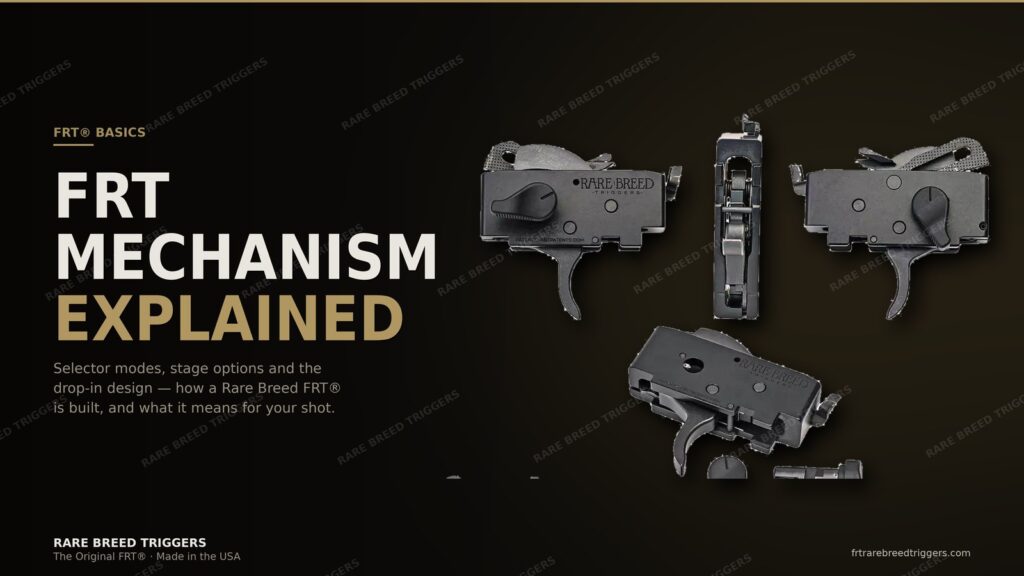
How that pull feels before the break is up to you. Rare Breed makes single-stage and two-stage versions, and every trigger carries a 3-position selector (Safe, Semi and FRT®) so you can run it as an ordinary semi-automatic trigger or switch the forced reset on at will. If you want the engineering view of selector modes, stages and the drop-in design, that all lives in FRT mechanism explained.
In a hurry? The three things that actually matter: it’s semi-automatic (one pull, one round), the firearm resets the trigger for you, and there’s a model for most popular platforms. Everything below is detail on those three.
Why it’s still semi-automatic
This is the part to be plain about. A forced reset trigger fires exactly one round for each pull of the trigger. The trigger must fully reset and be deliberately pulled again before another round can fire, and no setting changes that.
One pull, one round — every shot needs its own, separate trigger pull.
You stay in control — flip the selector to Semi and it behaves like any standard trigger.
Federally recognized — under a 2025 settlement with the U.S. Department of Justice, FRTs that fire one round per trigger function are not machine guns under federal law. We cover that in the 2025 DOJ settlement, explained.
State law is the separate question, and it’s the one that actually decides whether you can buy. Some states restrict FRTs regardless of federal status, so before you order, check are FRT triggers legal? and the state-by-state breakdown in FRT state laws. (General information, not legal advice.)
FRT vs. binary vs. bump stock
FRTs get lumped in with other “fast” devices they have nothing in common with. Two comparisons clear up almost all the confusion:
How each one behaves — at a glance.
Standard
Binary trigger
Rare Breed FRT®
Rounds per trigger function
One, on pull
One on pull, one on release
One, on pull
What resets the trigger
Your finger
Your finger (fires on release)
The firearm’s cycling
Follow-up speed
Standard
Fast
Fast
Selector modes
Safe / Fire
Safe / Semi / Binary
Safe / Semi / FRT®
Semi-automatic?
Yes
Yes
Yes
The headline difference: a binary trigger fires on the pull and on the release, while an FRT only ever fires on the pull. We go deeper in FRT vs. binary trigger. And because people constantly mix the two up, it’s worth saying clearly that an FRT is not a bump stock, a completely different device that works by moving the whole firearm; forced reset trigger vs. bump stock lays out why they’re not the same thing.
Choosing your first FRT
A forced reset trigger is a performance upgrade, so it rewards the shooter who’ll use it: competitors, anyone building a dedicated range gun, and anyone who just loves a fast, crisp reset. It also asks for more ammo and a reliably cycling firearm in return. The honest trade-offs are laid out in advantages and disadvantages of FRTs.
FRT®, FRT-15®, FRT-15L3® and FRT-15C3® are trademarks of Rare Breed Triggers. This article is general educational information about forced reset triggers and is not legal advice. Firearm laws vary by state and locality and can change; you are responsible for complying with all laws that apply where you live. Rare Breed Triggers does not ship to jurisdictions where its products are restricted. See are FRT triggers legal? for more.